
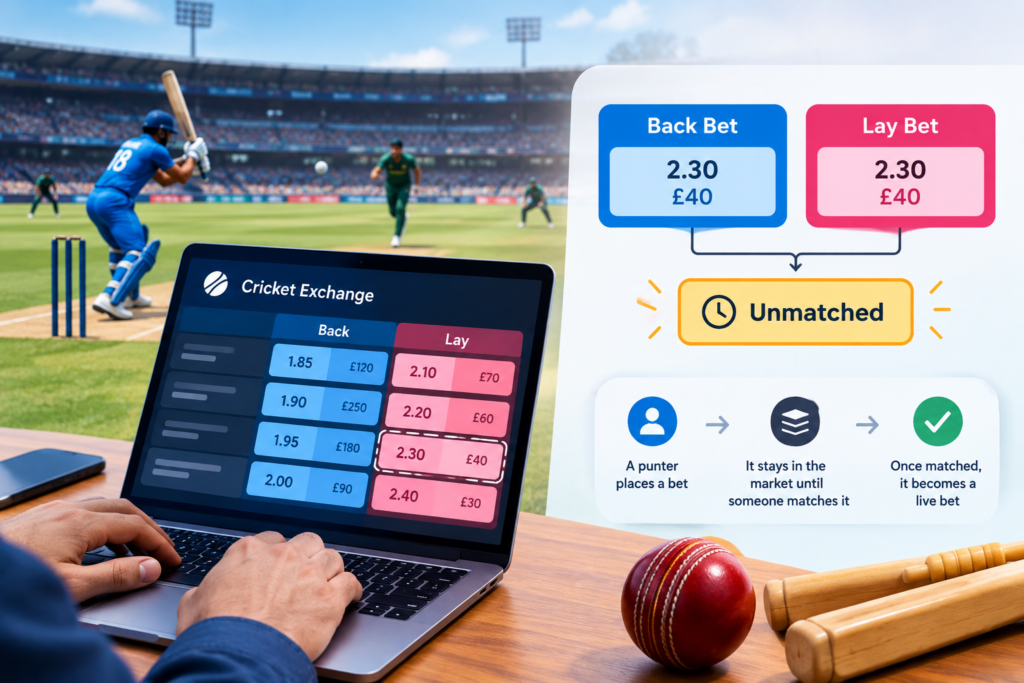
Watching a cricket market change from one price to another can be confusing when an order you placed does not get accepted straight away. Instead of being completed, it may appear as pending or unmatched. For someone new to exchange-style betting, that can raise a simple question: if the price was available when the order was placed, why did it not go through?
The answer comes down to how exchange markets work. Unlike a traditional bookmaker, an exchange connects participants who want to take opposite positions. An order needs compatible interest on the other side before it can be matched. For anyone using Tigerfair to follow cricket markets, understanding this distinction makes it much easier to interpret what is happening on the screen.
What Does an Unmatched Bet Mean?
An unmatched bet is an order that has been submitted but has not yet found a suitable opposing order at the requested price.
In simple terms, you have placed an offer, but another participant has not accepted those terms yet.
Consider a cricket team trading at odds of 2.00. You decide that you only want to back the team if the price reaches 2.10. You place an order at 2.10, but nobody is currently offering the opposing position at that price. Your order can remain unmatched.
This does not necessarily mean something has gone wrong. It is a normal feature of an exchange market.
The important distinction is between placing an order and having that order matched. A submitted order is not automatically a completed transaction simply because it appears in the market.
Matched and Unmatched Orders Are Different
A matched order has found compatible interest from another participant. The requested amount, or part of it, has therefore been accepted into the market.
An unmatched order is still waiting.
There can also be a third situation: a partially matched order. Suppose you want to place 100 units, but only 40 units are available at your chosen price. The 40 units may be matched while the remaining 60 stay unmatched.
This is particularly relevant in active cricket markets because available prices and amounts can change rapidly.
Why Does an Order Stay Unmatched?
The most straightforward reason is a lack of opposing interest at the price you selected.
Exchange markets are made up of orders from different participants. At any given moment, some prices may have more available money than others. If you choose a price where there is little or no opposing demand, your order may have to wait.
Price is therefore important.
Imagine the current market is around 1.80, but you want to back the same outcome at 2.00. You are effectively asking for a better price than the one currently available. Another participant would need to be willing to take the opposing side at 2.00 for your order to match.
If nobody does, the order remains open. This is one reason an exchange can feel different from a conventional sportsbook. The price you want and the price the market currently offers are not always the same.
How Cricket Odds Can Affect Matching
Cricket is particularly interesting because market prices can change quickly.
A single delivery can alter how participants assess a team’s chances. A wicket may reduce confidence in the batting side, while a boundary can produce the opposite reaction. Required run rate, remaining wickets, partnerships, bowling changes and match conditions can all contribute to repricing.
When those expectations change, available orders can move with them.
Suppose you place an order at 2.10. A few deliveries later, the batting team loses a key wicket and the market moves sharply. The price may now be very different from where it was when you submitted your order.
Your original order does not automatically become a completed transaction simply because the market has moved. Its status depends on whether compatible opposing interest becomes available under the applicable market rules.
This is why understanding the relationship between price movement and order matching is useful when following live cricket.
What Role Does Liquidity Play?
Liquidity is one of the most important concepts behind unmatched orders. In an exchange market, liquidity broadly refers to the amount of available market interest at different prices. A market with substantial liquidity may have more participants and more money available across several price levels.
A thinner market can have fewer orders and larger gaps between prices.
That difference matters because an order needs someone on the other side. If there is limited opposing interest at your chosen price, matching may take longer or may not happen at all.
Tigerfair already covers this subject in greater detail in its guide to market liquidity in betting. That article can be useful if you want to understand why some markets have more available interest than others.
For cricket betting, liquidity can also vary according to the match, competition, timing and stage of the game. A major fixture may attract considerably more activity than a less-followed match.
Can an Unmatched Order Become Matched Later?
Yes, an unmatched order can potentially become matched later if compatible market interest becomes available.
Using the earlier example, imagine you request a price of 2.10 when the market is around 2.00. There may initially be no opposing participant willing to accept 2.10.
Later, the market changes and another participant becomes willing to take the opposite position at that price. Your order may then be matched, subject to the available amount and the exchange’s rules.
But there is no guarantee that this will happen.
The market could move away from your requested price instead. Other participants may also cancel or change their orders. In a fast-moving live match, conditions can change several times within a short period.
So an unmatched order should be viewed as an open request, not as a guaranteed future transaction.
What Is a Partially Matched Bet?
A partially matched bet means that only part of the requested amount has been matched.
For example, you place an order for 200 units, but only 75 units can currently be matched at your chosen price. The 75-unit portion may be matched, while the remaining 125 units remain unmatched.
This distinction matters because the amount you originally entered is not necessarily the amount that has actually been matched.
When checking an exchange interface, it is therefore useful to look at the order’s status and distinguish between:
- The amount originally requested
- The amount already matched
- The amount still unmatched
- The price associated with the order
Understanding these figures helps prevent a common beginner mistake: assuming that submitting an order means the full amount has already been completed.
What Happens When a Cricket Market Moves Quickly?
Live cricket can produce some of the fastest changes in a market. A wicket during a chase, an unexpected collapse, a late surge of boundaries or a change in weather can alter expectations almost instantly. As participants react, available prices can move.
This can affect unmatched orders in several ways.
An order that was close to the current market may suddenly become less competitive. Another order may become attractive to someone on the opposite side. In some situations, market conditions can change so quickly that the price you initially saw is no longer available.
That is why live markets should be understood as continuously changing rather than as fixed-price environments.
Tigerfair’s existing content on live or in-play betting provides useful background on how markets operate once a cricket match is underway.
What Is the Difference Between an Unmatched Order and a Rejected Order?
These terms should not be confused. An unmatched order has generally been submitted to the market but has not found compatible opposing interest.
A rejected order, depending on the platform and circumstances, may not have been accepted into the market at all. The reason could relate to market status, account conditions, technical restrictions or other applicable rules.
The exact terminology and handling can vary between platforms, so users should check the relevant exchange’s rules when a particular message appears on screen.
The key idea is simple: unmatched does not necessarily mean rejected.
How Back and Lay Orders Connect to Matching
The concept becomes easier once you understand the basic idea behind back and lay positions.
A back order expresses interest in an outcome happening. A lay order represents the opposing position. For an exchange transaction to occur, compatible interest needs to exist on both sides.
This is why exchange markets can be thought of as a meeting point between opposing orders.
Understanding that process makes an unmatched order much less mysterious. It is essentially an order waiting for the market to provide the required opposite side.
Should You Cancel an Unmatched Order?
There is no universal answer because the right action depends on the circumstances and the platform’s available controls.
If the market has moved significantly and the original price no longer reflects what you intended, you may want to review the order rather than simply leave it open. In other cases, you may still be comfortable waiting for the requested price.
The important point is to know what is currently open and what has already been matched.
Users should also understand that live cricket markets can change rapidly. Leaving an order open means market conditions may be different if matching eventually occurs. Always review the applicable exchange rules and the order status shown by the platform.
A Simple Cricket Example
Imagine a team is currently trading at 1.90. You would prefer to back it at 2.00, so you submit an order at that price.
At the moment you submit it, there is no suitable opposing interest at 2.00. The order remains unmatched.
A few minutes later, the team scores three boundaries. Other participants become more confident in its position, and market prices change.
Your order might still remain unmatched because the market has moved away from the price you requested.
Alternatively, if the market later moves toward 2.00 and compatible opposing interest becomes available, some or all of your order could potentially be matched.
The example shows why an exchange price is not simply a number displayed by the platform. It reflects the interaction between participants and the orders available at that moment.
Why Understanding Unmatched Bets Matters
For beginners, the most important lesson is that an order and a completed transaction are not necessarily the same thing.
Once you understand that difference, several other exchange concepts become easier to follow. Liquidity makes more sense. Back and lay prices become easier to interpret. Sudden market movements become less confusing. Most importantly, you can distinguish between what you requested and what has actually been matched.
This knowledge is especially useful when following cricket live, where market conditions can change after individual deliveries.
For Tigerfair readers, learning these fundamentals provides a stronger foundation for understanding cricket betting markets without relying on assumptions about how every displayed price works.
Conclusion
An unmatched bet is simply an order that has not yet found compatible opposing interest at the requested price. It may later be matched, partially matched or remain unmatched, depending on market activity, available liquidity, price movement and the relevant exchange rules.
The easiest way to understand the process is to remember four things: the price you request, the opposing interest available, the liquidity in the market and how quickly conditions are changing.
Once those pieces fit together, an unmatched order stops looking like an error and starts making sense as a normal part of exchange-based cricket markets.
FAQs
What does an unmatched bet mean?
It means an order has been submitted but has not yet found suitable opposing interest at the requested price.
Why do cricket exchange bets remain unmatched?
The most common reason is that there is no compatible opposing order available at the selected price. Limited liquidity can also make matching more difficult.
Can an unmatched bet become matched later?
Yes. If compatible opposing interest becomes available while the market remains open, an unmatched order may become fully or partially matched according to the applicable rules.
What does partially matched mean?
It means only part of the requested amount has been matched. The remaining amount may stay open as an unmatched order.
Does liquidity affect unmatched bets?
Yes. Markets with more available liquidity generally have more opposing interest across different prices, while thinner markets may have fewer available orders.
Can cricket odds change while an order is unmatched?
Yes. Live cricket markets can move after events such as wickets, boundaries, changes in required run rate and other match developments.
Is an unmatched bet the same as a rejected bet?
No. An unmatched order has been submitted but has not found compatible market interest. A rejected order may not have been accepted into the market in the first place.
Can an unmatched order be cancelled?
The available controls depend on the exchange and market rules. If cancellation is permitted, users should review an order before deciding whether to leave it open or remove it.