
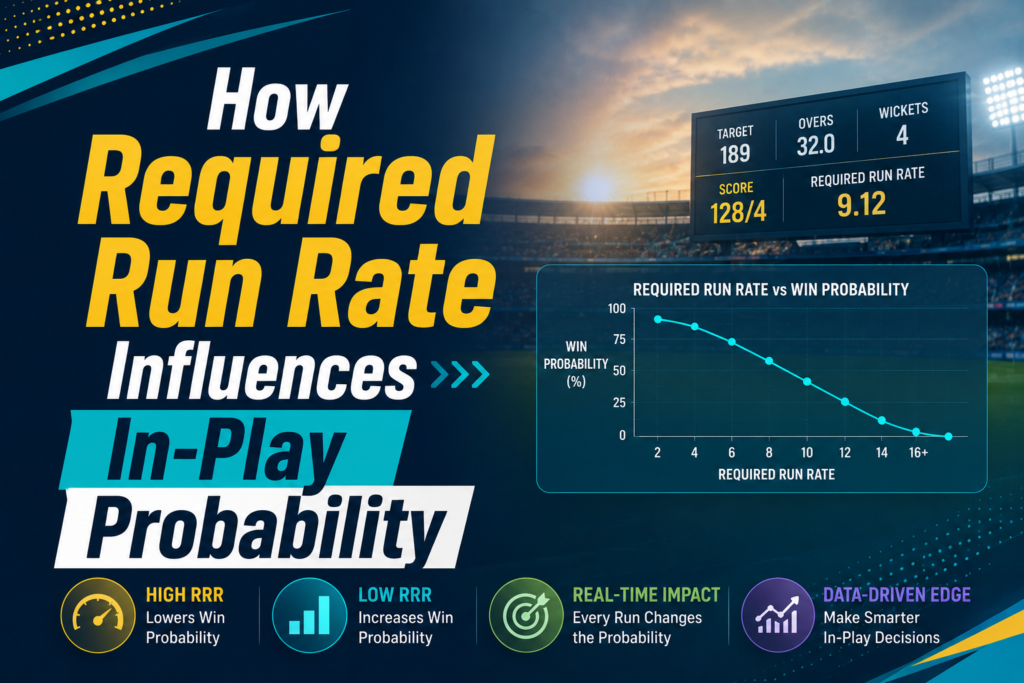
Anyone who has watched the last ten overs of a close run chase knows the feeling. One boundary and the mood in the stands flips completely. That shift isn’t random. It’s the required run rate doing exactly what it’s designed to do: telling everyone watching, betting, or commentating how hard the chasing team actually has to work from this point forward. Once you understand how that single number moves live probability models. The whole second innings starts to make a lot more sense. Whether you’re following the game casually or watching the odds move on Tigerfair.
What Is Required Run Rate and Why It Matters
Required run rate (RRR) is simply the runs a team needs per over to win, calculated from the balls and runs remaining. It sounds basic, but it’s the backbone of almost every in-play win probability model used in modern cricket broadcasts and analytics platforms. A chasing side sitting at 6.2 needed per over with eight wickets in hand is in a completely different situation than a side needing 6.2 with three wickets down and two set batters gone. The number alone never tells the full story. It’s the relationship between RRR, wickets in hand, and pitch conditions that analysts actually care about.
What makes RRR such a powerful input is that it updates ball by ball. A single dot ball can push the number up by a tenth of a run. A six can drop it by nearly a full run in one strike. That volatility is exactly why in-play probability swings so sharply during T20 and ODI run chases. And why casual fans often feel the match “turn” before they can explain why.
How In-Play Probability Models Read the Run Rate
Live win probability isn’t calculated off RRR alone. Modern models weigh three things together: the current required run rate, wickets remaining, and historical scoring patterns from similar match situations. Often pulled from thousands of past innings on similar pitches. When RRR climbs past what’s historically achievable with the wickets left. Probability shifts sharply toward the bowling side, even if the required rate still looks “chaseable” on paper.
This is where a lot of viewers misread the game. A required rate of 9 an over with seven wickets standing is genuinely different from 9 an over with three wickets standing. Even though the raw number is identical. Good models account for this by treating RRR as a moving target rather than a fixed line.
The Role of Wickets in Adjusting Probability
Wickets act as a multiplier on how much RRR pressure a chasing team can absorb. Lose a set batter at a critical stage and the required rate effectively becomes harder to achieve. Even if it hasn’t technically changed. Because the players facing it are less equipped to handle it. This is why probability graphs often show a steeper drop after a key dismissal than after several dot balls. Even when both events raise RRR by a similar margin. Anyone reading in-play numbers seriously has to watch wickets and run rate together, never one in isolation.
Required Run Rate Swings and Momentum in Live Matches
Momentum in cricket is mostly RRR in disguise. A boundary-heavy over doesn’t just add runs. It resets the required rate downward and, with it, resets the psychological pressure on the bowling side. Conversely, two tight overs with no boundaries can let RRR creep up quietly until it suddenly looks alarming. Broadcasters flash these numbers constantly because they’re the clearest shorthand for “who’s winning right now,” even before a result is close to decided.
This is also why watching only the scoreboard total can be misleading. Two teams can be at the exact same score at the same over mark, yet have completely different required run rates depending on how the powerplay was used, meaning their in-play probability can look nothing alike.
Reading In-Play Odds the Smart Way
For fans who follow live match odds alongside the cricket itself, understanding RRR is the single most useful skill for interpreting why a probability line moved. Platforms like Tigerfair display these shifts in real time. Once you know that a probability jump usually traces back to a change in required rate or a fresh wicket, the numbers stop feeling arbitrary. It also encourages a more grounded approach to fair play betting, reading the actual match situation rather than reacting to a total score that doesn’t tell the whole story.
Treating RRR as context rather than a standalone statistic also helps avoid overreacting to short-term swings. A rate that spikes for one over because of two dot balls doesn’t automatically mean the chase is over; a rate that stays elevated across three or four overs, paired with falling wickets, is a much stronger signal.
Common Mistakes Fans Make When Judging RRR
A few habits consistently lead people to misjudge a chase. Watching the required rate without checking wickets remaining is the biggest one. A “safe” 6 per over means little with only two batters left who can hit boundaries. Ignoring the specific pitch and ground is another; a required rate of 10 an over is far more achievable on a small, flat-scoring ground than on a slow, low one. Finally, treating RRR as fixed rather than dynamic causes people to miss momentum shifts that models pick up instantly, because a probability engine recalculates after every single delivery, not every over.
FAQs
What does required run rate actually measure? It measures the average runs per over a chasing team needs from the remaining balls to reach the target, recalculated after every delivery.
Why does in-play probability change so fast during a chase? Because models recalculate using RRR, wickets in hand, and historical scoring data after each ball, so a single boundary or dismissal can shift the numbers noticeably.
Is a low required run rate always a safe sign? Not necessarily. A low RRR with very few wickets left can still carry real risk, since there may not be enough recognized batters to see the innings through.
How is required run rate different from current run rate? Current run rate reflects what’s already been scored; required run rate looks forward, showing what’s still needed to win from this point on.
Why do required run rate and wickets need to be read together? Because the same required rate can be easy or extremely difficult to chase depending on how many recognized batters remain, which is why serious analysis and fair play betting decisions always weigh both factors together rather than looking at RRR alone.