
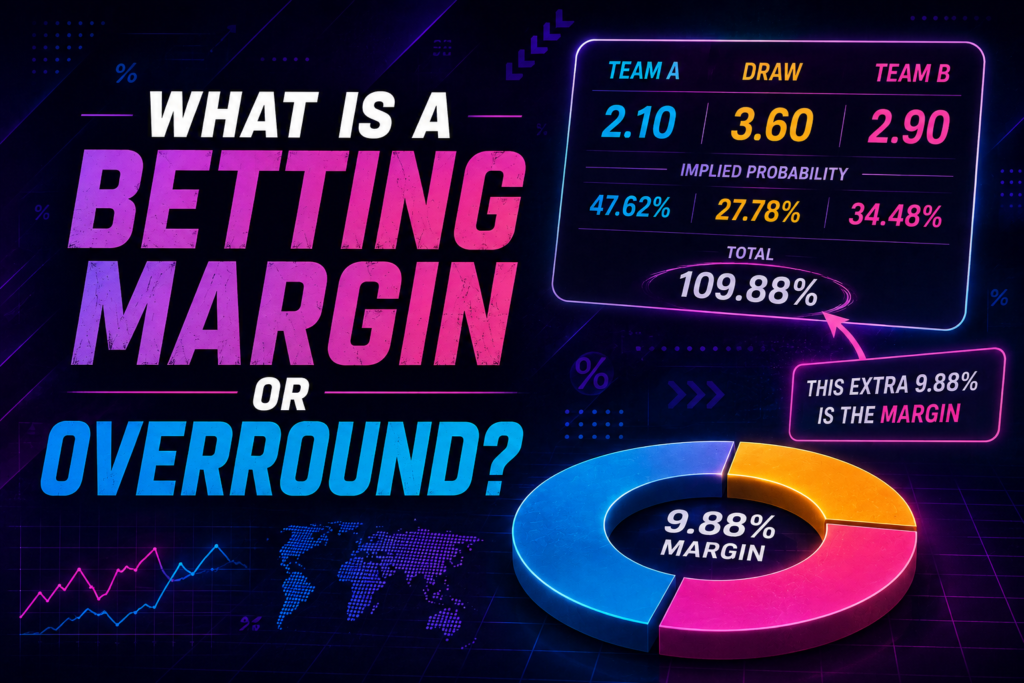
For readers exploring sports markets on Tigerfair, understanding how prices are structured is just as important as understanding the event itself. One term that frequently appears in betting mathematics is “overround,” also known as the betting margin or bookmaker margin. It describes the difference between the combined implied probabilities represented by listed odds and a theoretical 100% probability.
At first, the concept can sound complicated. In practice, it is relatively straightforward. If the implied probabilities of all possible outcomes add up to more than 100%, the amount above 100% represents the market’s built-in margin. Understanding this figure can help readers interpret odds more accurately and distinguish between the probability suggested by a price and the underlying mathematical margin.
The concept applies across many sports and markets, although the size of the margin can vary considerably depending on the event, market type, competition, and number of outcomes.
Tigerfair: Understanding Betting Margin and Overround
A betting margin is essentially a mathematical way of describing the extra percentage built into a market.
Consider a simple two-outcome event with these decimal prices:
- Outcome A: 1.80
- Outcome B: 2.00
To convert decimal odds into implied probability, use:
Implied probability = 1 ÷ decimal odds × 100
For Outcome A:
1 ÷ 1.80 × 100 = 55.56%
For Outcome B:
1 ÷ 2.00 × 100 = 50%
Add the two implied probabilities:
55.56% + 50% = 105.56%
The market therefore has an overround of:
105.56% − 100% = 5.56%
That 5.56% is the theoretical market margin represented by those prices.
It is important to understand that this calculation does not mean an operator will necessarily earn exactly 5.56% from every individual event. Actual outcomes, market activity, pricing changes, and other factors affect real-world results.
How Implied Probability Works
Before understanding overround, it helps to understand implied probability. Decimal odds can be converted into an implied probability by dividing 1 by the decimal price.
For example:
2.00 odds = 50% implied probability
4.00 odds = 25% implied probability
5.00 odds = 20% implied probability
The lower the decimal price, the higher the implied probability.
When several outcomes are available, their implied probabilities can be added together. If the total exceeds 100%, the difference is the overround. This provides a useful mathematical snapshot of how a market is priced.
Why Does the Total Exceed 100%?
In a perfectly balanced theoretical probability model, mutually exclusive outcomes would add up to 100%.
For example, imagine an event with only two possible outcomes:
- Team A: 50%
- Team B: 50%
The total would be 100%.
Actual betting markets generally do not display prices corresponding exactly to those probabilities. Instead, prices incorporate a margin.
That means the displayed odds may imply:
- Team A: 53%
- Team B: 52%
The combined figure becomes 105%.
The additional 5 percentage points represent the overround. This is one reason comparing odds requires more than simply identifying which outcome has the shortest price.
How Tigerfair Users Can Calculate an Overround
The calculation can be completed in three simple stages. First, collect the decimal odds for every possible outcome.
Second, convert each price into an implied probability using:
1 ÷ decimal odds × 100
Third, add all the implied probabilities together and subtract 100%.
For example, consider a three-outcome market:
- Home: 2.20
- Draw: 3.40
- Away: 3.10
The implied probabilities are approximately:
- Home: 45.45%
- Draw: 29.41%
- Away: 32.26%
Total:
107.12%
Therefore:
107.12% − 100% = 7.12% overround
The calculation gives a simple way to estimate the margin represented by the listed prices.
Betting Margin vs Probability
One of the most common misunderstandings is treating the implied probability of an outcome as its true probability. They are not necessarily the same.
If an outcome is listed at 2.00, its implied probability is 50%. That does not mean there is objectively a 50% chance of the outcome occurring. The price is a market representation.
The actual probability could be higher or lower depending on factors such as player availability, team strength, injuries, weather, venue conditions, and other relevant information.
The overround makes this distinction even more important because the implied probabilities across a market are deliberately greater than 100% in total.
Why Margin Size Matters
Not all markets have the same overround. A highly competitive market involving a major sporting event may have relatively tight pricing, while a smaller or more specialized market can have a larger margin.
The number of outcomes can also influence how the calculation looks. A two-way market is mathematically different from a three-way market, while player-specific and proposition markets may have their own pricing structures.
For users comparing markets, a lower theoretical margin generally means the listed prices are closer together from a mathematical perspective. However, margin alone should not be used to determine whether a particular market is suitable.
Overround in Cricket Markets
Cricket provides several useful examples because markets can cover different aspects of the game. A match-winner market may have two outcomes in some formats or three where a draw is possible.
Other markets may relate to:
- Total runs
- Top batter
- Top bowler
- Team totals
- Innings results
- Specific match events
Each market can have a different pricing structure.
For example, a Test match winner market may include a draw, while a T20 match generally has a winner and no draw because a tied match is resolved through the applicable competition rules. This changes how the implied probabilities are calculated.
Why Overround Changes
Market prices are not necessarily fixed. They can change when new information becomes available. Team announcements, injuries, weather conditions, toss results, player availability, and major developments during a match can all influence prices.
When individual prices change, their implied probabilities change as well. Consequently, the total implied probability and therefore the calculated overround can change.
This is one reason calculations based on a screenshot or historical price may not accurately represent the current market.
Pre-Match and In-Play Markets
Overround can be examined in both pre-match and in-play markets. Before an event begins, pricing is based on information available at that time.
Once play starts, new information becomes available continuously. In cricket, a wicket, boundary, injury, rain interruption, or change in required run rate can affect expectations quickly.
As prices move, the implied probabilities move with them. This makes in-play calculations more dynamic than pre-match calculations. It also means that a market’s apparent margin at one moment may not remain identical later.
Does a Higher Overround Mean Worse Odds?
From a purely mathematical perspective, a higher overround means more margin is incorporated into the collection of prices.
However, the relationship is not quite as simple as saying that every market with a higher calculated percentage is automatically inferior in every circumstance.
Different markets may have different levels of liquidity, information availability, volatility, and outcome complexity.
A specialized market can naturally have different pricing characteristics from a highly liquid major match market. The calculation is therefore best used as one analytical measure rather than the only factor.
How to Remove the Margin Mathematically
Analysts sometimes calculate “fair” or normalized probabilities by adjusting the implied probabilities so they add to exactly 100%.
Suppose a market has implied probabilities of:
- 50%
- 30%
- 25%
The total is 105%.
To normalize them, each probability can be divided by 105% and then multiplied by 100. The resulting figures provide a theoretical probability distribution with the margin removed. This can help analysts compare the market’s implied distribution with their own probability estimates.
However, the normalized figures should still not be treated as objective truth. They are simply a mathematical adjustment of the listed prices.
Common Mistakes When Calculating Overround
A frequent mistake is forgetting to include every possible outcome. If a market has three outcomes, all three prices need to be included.
Another mistake is using the wrong formula.
For decimal odds, the basic calculation is:
1 ÷ odds
The result is then multiplied by 100 to express it as a percentage. It is also easy to confuse margin with profit.
An overround is a pricing calculation. It does not mean that an operator will receive the calculated percentage as guaranteed profit from every market. Actual financial results depend on the distribution of outcomes and market activity.
Why This Concept Is Useful for Cricket Analysis
Understanding overround can improve the way readers interpret cricket markets. Instead of looking only at one price, they can examine the entire market and calculate its implied probability total.
That provides additional context.
For example, two markets may show similar prices for a particular team, but their overall implied probability totals could differ.
The comparison becomes more informative when the market structure is considered alongside team statistics, venue conditions, current form, and other relevant information.
Responsible Interpretation of Betting Mathematics
Mathematical concepts such as implied probability and overround can help explain how markets work, but they cannot guarantee the outcome of a sporting event.
Cricket remains uncertain. A strong team can lose, a favorite can struggle with conditions, and a match can change dramatically after one over.
Anyone using sports markets should understand the financial risks involved and check the laws, age requirements, licensing arrangements, and responsible-use provisions applicable in their location. Mathematics can describe a market; it cannot eliminate uncertainty.
Conclusion
Betting margin and overround are useful concepts for anyone who wants to understand how sports-market prices are constructed.
The basic idea is simple: convert each decimal price into an implied probability, add those probabilities together, and compare the result with 100%. The amount above 100% represents the calculated overround.
For readers researching Tigerfair, understanding this calculation provides useful context when examining cricket and other sports markets. It explains why the probabilities implied by listed prices do not normally add up to exactly 100%.
The concept is particularly useful when comparing different markets, understanding pricing structures, and separating implied probability from actual probability.
Ultimately, overround is a mathematical description of market pricing not a prediction of what will happen. Combining it with reliable sporting information and a realistic understanding of uncertainty provides a much clearer picture of how betting markets work.
Frequently Asked Questions
What is a betting margin?
A betting margin is the mathematical advantage incorporated into a set of market prices. It can be estimated by adding the implied probabilities of all possible outcomes and comparing the total with 100%.
What does overround mean?
Overround is the amount by which the combined implied probabilities of all outcomes exceed 100%. For example, if the total is 106%, the overround is 6%.
How do you calculate overround?
Convert each decimal price into an implied probability using 1 divided by the decimal odds. Add the resulting percentages together and subtract 100%.
Is overround the same as guaranteed profit?
No. Overround describes the mathematical structure of market prices. It does not guarantee a specific profit from an individual event or market.
What is a good betting margin?
There is no universal figure that applies to every market. Margins can vary according to sport, competition, market type, liquidity, and the number of possible outcomes.
Why can overround change during a cricket match?
Prices can change as new information becomes available. Wickets, runs, injuries, weather interruptions, and other developments can alter implied probabilities and therefore change the calculated total.
Can overround tell me who will win?
No. It describes the relationship between listed prices and implied probabilities. It does not guarantee the outcome of a sporting event.
Why is understanding implied probability useful?
It allows readers to translate decimal prices into percentages and better understand what those prices mathematically represent. This can make comparisons between markets easier and more transparent.